DenebMesh
A mesher made for aircraft.
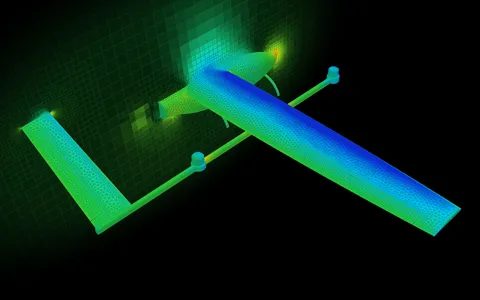
DenebMesh is Deneb’s own CFD mesher for UAVs and drones. This is one Raven meshed twice: the left wing by cfMesh, the right wing by DenebMesh at Coarse. Both halves were solved; switch to Pressure to see the answer on each.
cfMesh5,645,277 cells
meshed in 3 min 11 s
DenebMesh3,991,534 cells at Coarse
meshed in 26 s
Loading the mesh
Two runs of the Raven at 2°: cfMesh at 20 m/s, DenebMesh at Coarse and 18 m/s. The pressure is shown as a coefficient, so the two halves compare.
- 26 s
To mesh the Raven at Coarse
3,991,534 cells with thin layers on every wall. cfMesh took 3 min 11 s for its 5,645,277.
- 55 s
At Standard, the default
The Raven from its CAD at the level a polar uses by default: 5,632,327 cells. Below, it is set beside Coarse.
- 280,208
Triangles on the Raven’s skin
DenebMesh follows the surface with triangles and stacks prisms on them. cfMesh cuts the aircraft out of a grid of cubes.
Cut it open and look at the cells.
A plane through the mesh shows every cell it crosses, with the aircraft cut away in front of it. Polar is the wall-resolved mesh behind a polar, here at Coarse; Quick look is the wall-function mesh behind a first answer.
Loading the mesh
The Raven at 2° and 18 m/s, wall-resolved at Coarse: 3,991,534 cells, meshed by DenebMesh in 26 s.
The same Raven as a Quick look, with wall functions: 2,038,799 cells, meshed by snappyHexMesh, the Quick look mesher, in 13 minutes.
Layers on the wall
Choose Wing section, then Leading edge: the thin cells that carry the boundary layer wrap the nose of the wing.
Fine where the flow turns
Cells are smallest at leading edges, tips and the gaps beside control surfaces, and grow with distance from the aircraft.
The pressure, cell by cell
Pressure colours each cell with the value solved in it. Nothing is smoothed between cells on the planes.
Coarse or Standard
One Raven at two levels, wing by wing.
The same Raven from its CAD at 6°, meshed twice by DenebMesh: the left wing at Coarse, the right at Standard, the level a polar uses by default. Coarse has 27% fewer cells and meshes in 44 s instead of 55 s. Standard puts more triangles on the skin and more layers on the wall.
Coarse4,110,441 cells
meshed in 44 s
Standard5,632,327 cells
meshed in 55 s
Loading the mesh
Both from the Raven’s CAD at 6°, wall-resolved, by the DenebMesh in the 0.2.0 release, on 3 threads. The meshes alone: these two were not solved.
- 0.73
Cells at Coarse, against Standard
4,110,441 cells against 5,632,327, for the first answers and quick changes.
- 286,438
Triangles on the skin at Coarse
345,072 at Standard. Choose Across the wing to see the cells grow coarser away from the wall.
- 16 / 20
Layers on the wall, at most
Coarse stacks up to 16 thin cells on the wall, Standard up to 20. Both passed DenebMesh’s quality check.
Against a wind tunnel
NASA’s RAVEN-SWFT, meshed both ways and solved the same way.
NASA published this model’s shape and its tunnel results. The same STL went to cfMesh and to DenebMesh, then through the same solver settings: fully turbulent k-ω SST, wall-resolved, at 2° and 4°. DenebMesh used 26 to 30% fewer cells, each iteration took about a third less time, and between the two angles its pitching moment changed as the tunnel’s did, where cfMesh’s changed three times as fast.
Loading the mesh
RAVEN-SWFT as DenebMesh meshes it from NASA’s public model, meshed again for this viewer by today’s DenebMesh: 3,535,133 cells in 15 s. The validation runs below were meshed by an earlier build, in 22–26 s.
- NASA 12-Foot tunnel
- cfMesh
- DenebMesh
- NASA 12-Foot tunnel
- cfMesh
- DenebMesh
- NASA 12-Foot tunnel
- cfMesh
- DenebMesh
| Tunnel | cfMesh | DenebMesh | |
|---|---|---|---|
| Lift at 2° / 4° | 0.485 / 0.676 | 0.514 / 0.705 | 0.521 / 0.715 |
| Drag at 2° / 4° | 0.0951 / 0.1088 | 0.0946 / 0.1147 | 0.0966 / 0.1071 |
| Pitching moment slope, per degree | −0.0055 | −0.0168three times too steep | −0.0060 |
| Cells | 4.8–5.1 million | 3.55 million | |
| Meshing | 57–72 s | 22–26 s | |
| Seconds per iteration | 8.2–8.3 | 5.2–5.9 |
Both meshes give 4 to 7% more lift than the tunnel at the same angle; the model’s as-built wing and tail setting were not published, which may account for an offset. Tunnel data: NASA LaRC 12-Foot Low-Speed Tunnel, propellers off (Simmons, Geuther and Ahuja, AIAA AVIATION 2023, Fig. 8).
Leading edges stay round.
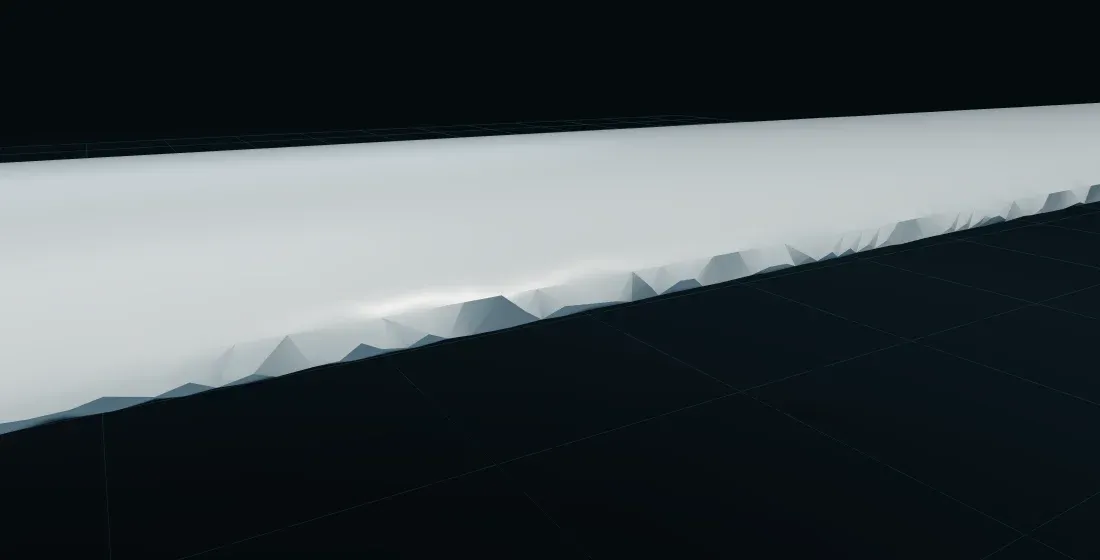
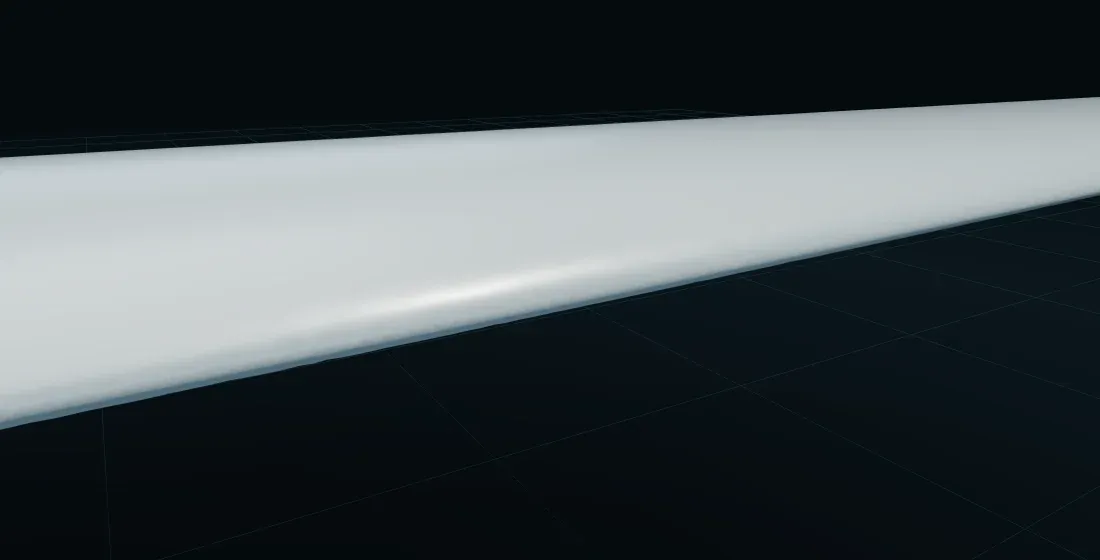
The same wing read from the same STEP file, in version 0.1 and in 0.2.0. Version 0.2.0 reads thin, rounded edges in finer detail, so leading edges stay round before the mesher sees them.
Meshed and checked before anything is queued.
The Mesh step meshes the first run of an analysis and shows its cells, its time per run and its memory. Where a mesh fails, the place is shown on the aircraft.
Coarse or Standard
Coarse has about 30% fewer cells, for a quicker first look. Our validation uses Standard.
A fallback that says why
Where DenebMesh fails on an aircraft, cfMesh takes over and the run says so.

Where a mesh fails, you see the spot.
On this Raven run, DenebMesh’s own check refused a mesh whose wall stood 1.3 mm off the surface at the tail end. The Studio flies to the place, says what happened and what to change in the CAD. cfMesh meshed the run instead, and the run went on.