Supersonic
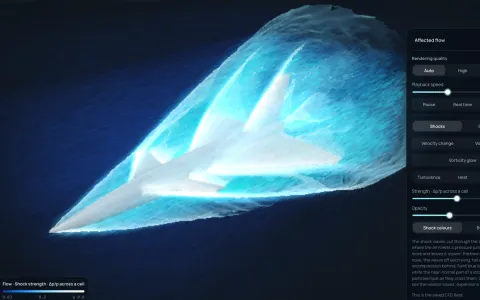
Every shock wave of a jet at Mach 4.
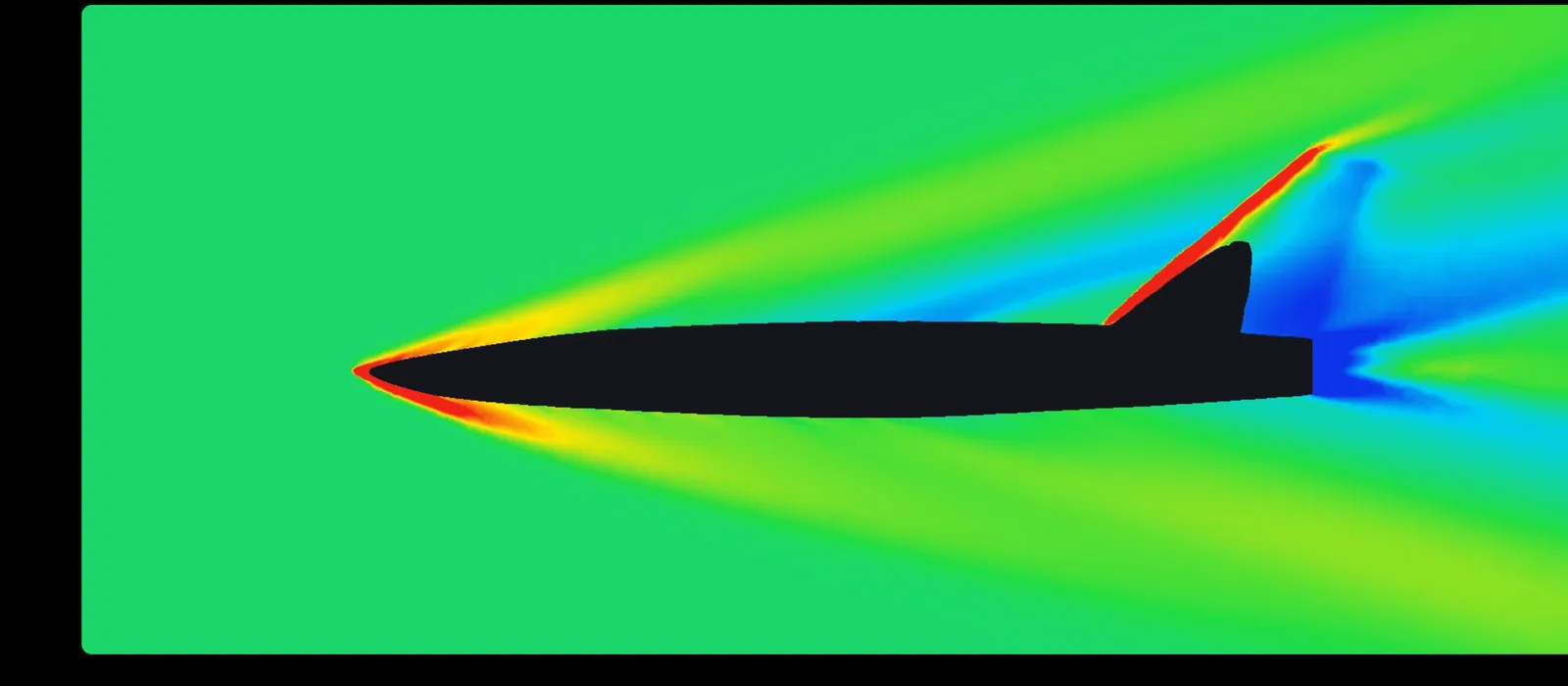
From Mach 0.3 up, Deneb Aero solves the air as a compressible gas, checked against wind tunnels case by case. This is a 1.9 m jet at Mach 4, its shock waves coloured by the pressure lost across each one.
- Every shock wave of the jet, in 3D. The solver’s own shock surfaces round a 1.9 m jet at Mach 4.
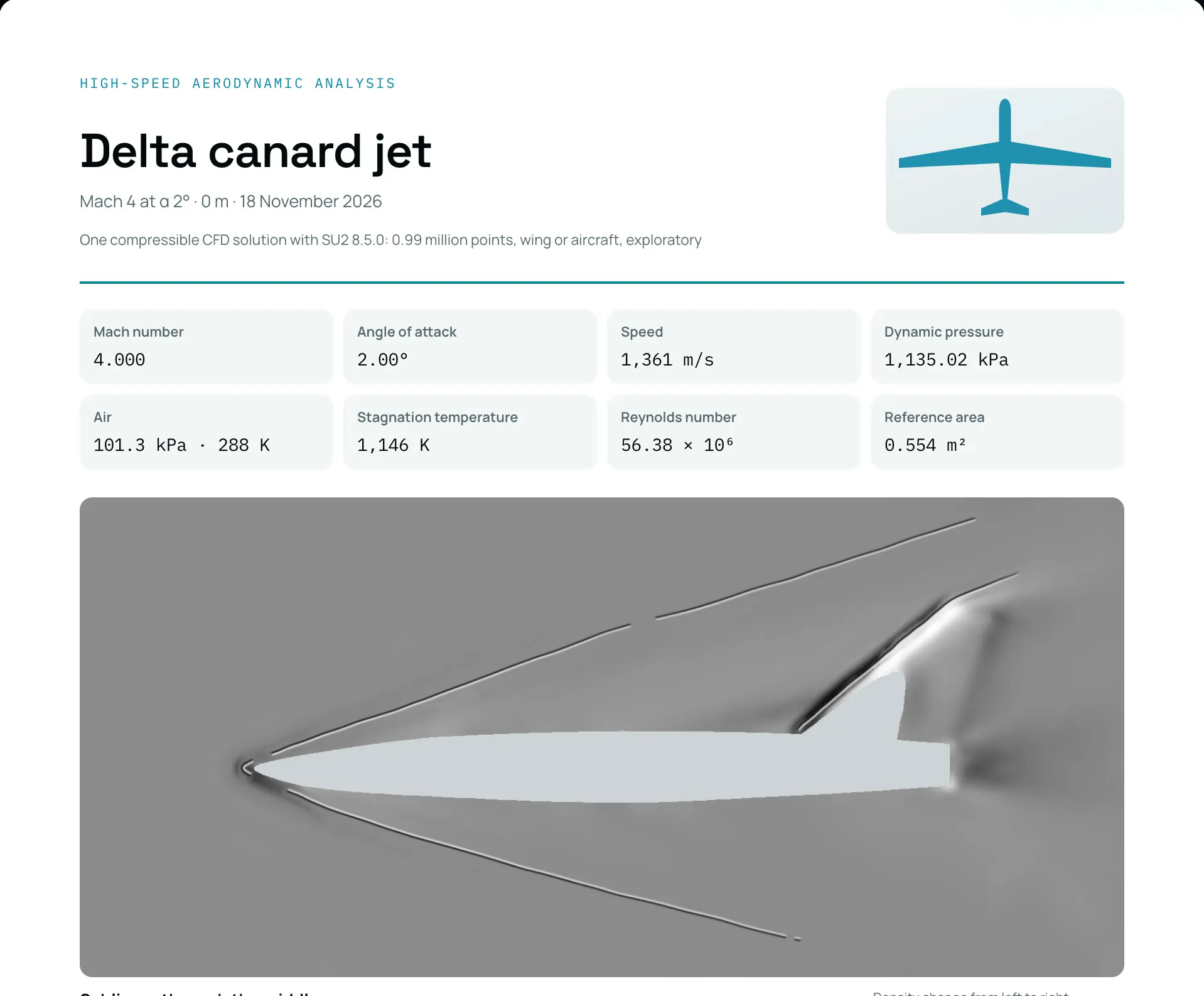
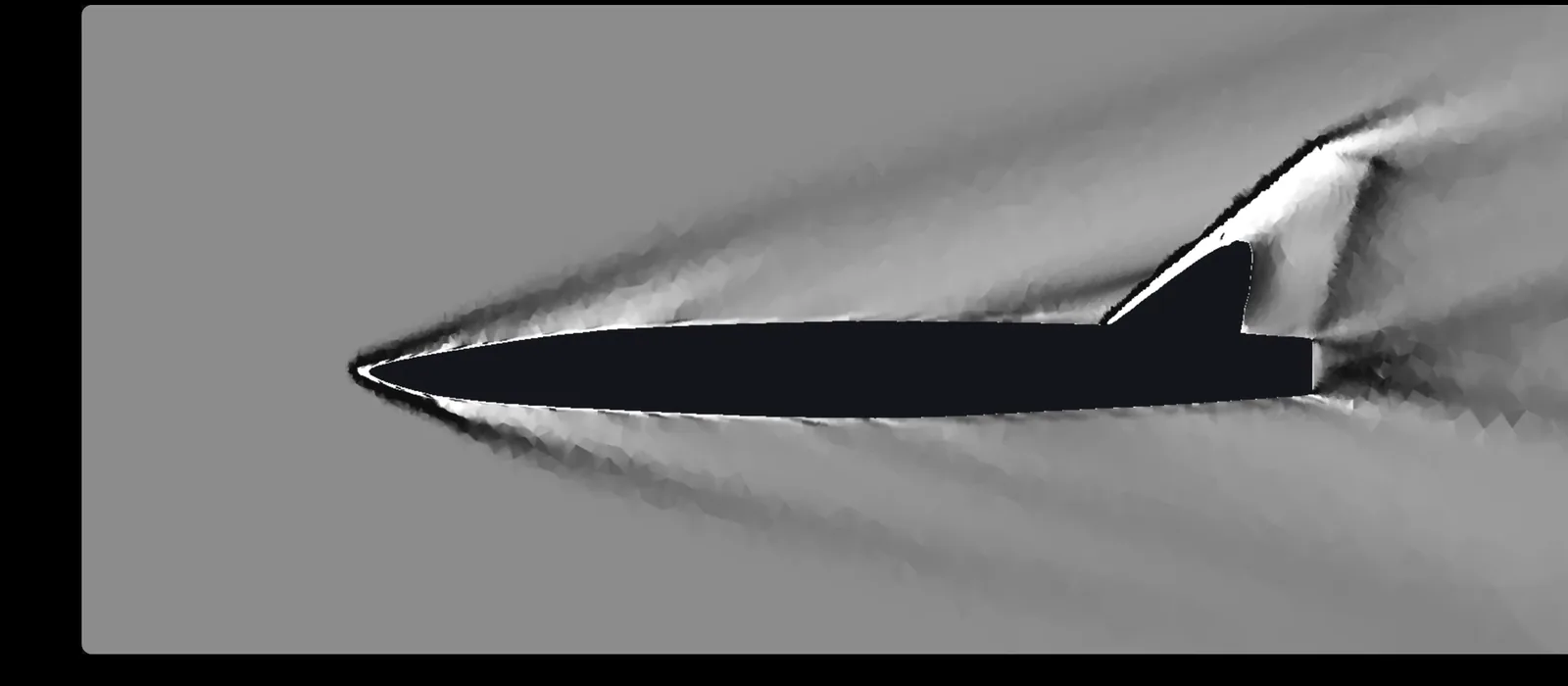
- Then as a wind tunnel sees it. The centre plane as a knife-edge schlieren: the bow shock, the fin’s shock and the expansion behind it.
- And what the shocks do to the pressure. The same plane by pressure coefficient: high behind each shock, low in the wake.
- 2%
Normal force on HB-2 at Mach 3
Within 2% of tunnel data for the HB-2 standard model, up to 20° angle of attack. Forebody axial force within 0.5%.
- 2 to 4%
Drag of a delta wing at Mach 4.63
Low against NASA’s tunnel data, with the lift slope 3% low.
- 0.3 dB
Sonic boom on the ground
Against NASA’s sBOOM on the same body, under the flight track and 45° to its side.
Then the boomarrives.
- Mach 4, 300 m above the ground. The jet outruns its own sound, so nothing is heard as it passes.
- Its shock waves trail behind as a cone and meet the ground along this curve.
- The boom reaches the tower 0.99 s after the jet has passed: 493 Pa above the air’s pressure, heard as one bang.
The boom on the ground
What the tower hears, and what it sounds like.
The jet’s shock waves are carried from the solved flow down to the ground through the air, as NASA’s sBOOM does, and checked against it within 0.3 dB. At the tower they arrive as an N-wave: a sudden rise, a steady fall below the air’s pressure, and a second jump back.
- Peak
- +493 Pa
- Front to rear shock
- 8.4 ms
- Heard
- One bang: the two shocks are too close together for the ear to tell apart
- Loudness
- 130 PLdB
Turn your volume down first. Speakers drop the lowest notes, which carry most of a boom, so you hear its crack, not its thump.
Validation
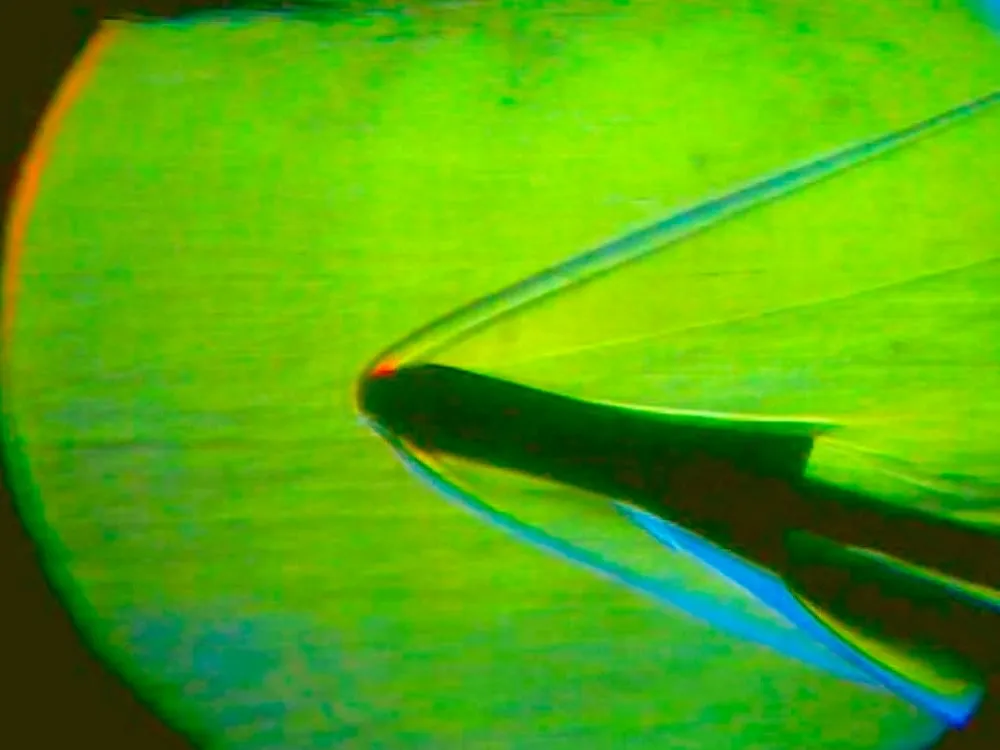
The tunnel’s photograph, and ours.
The HB-2 standard model at 20°, solved at the tunnel’s Mach number and drawn through the same kind of colour schlieren filter. The shocks leave the nose and the flare at the same angles.
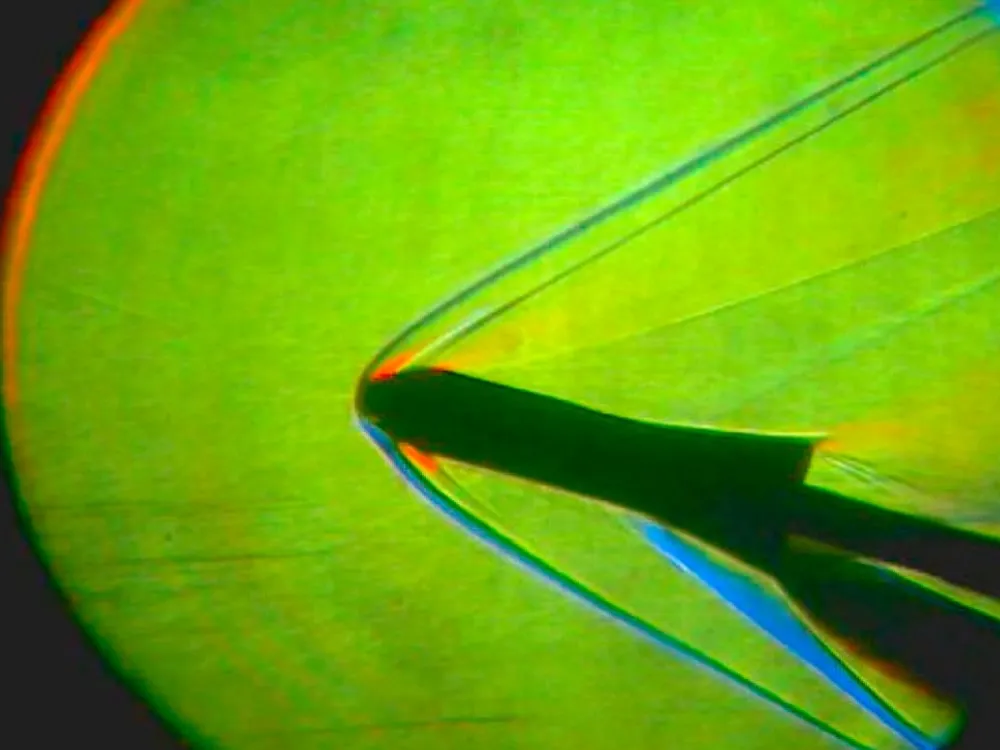
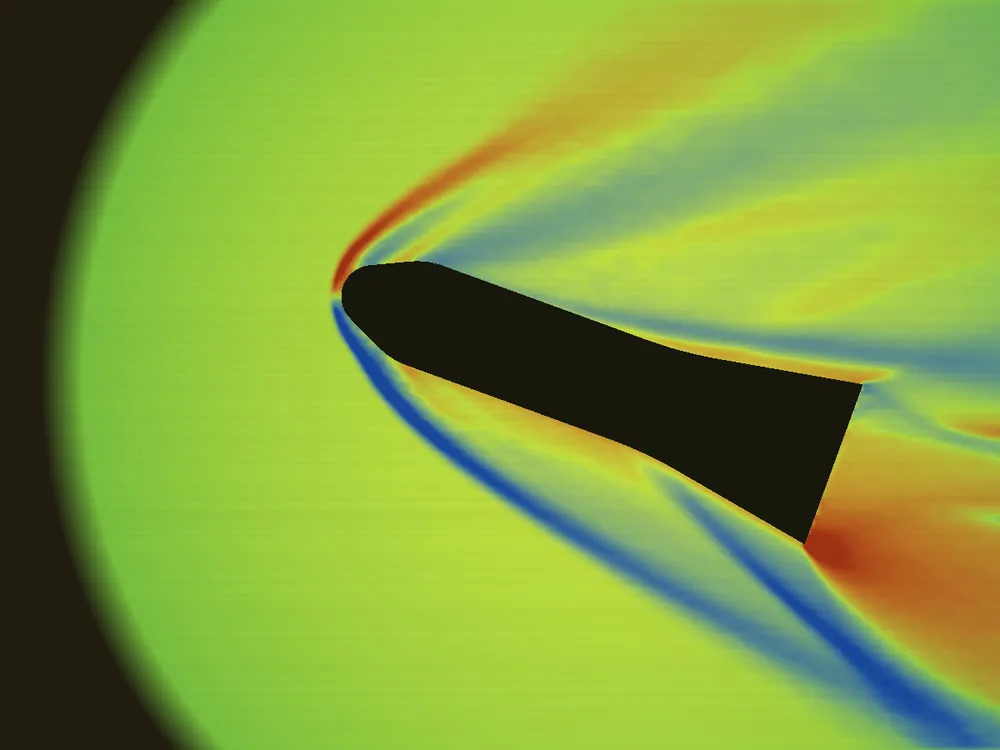
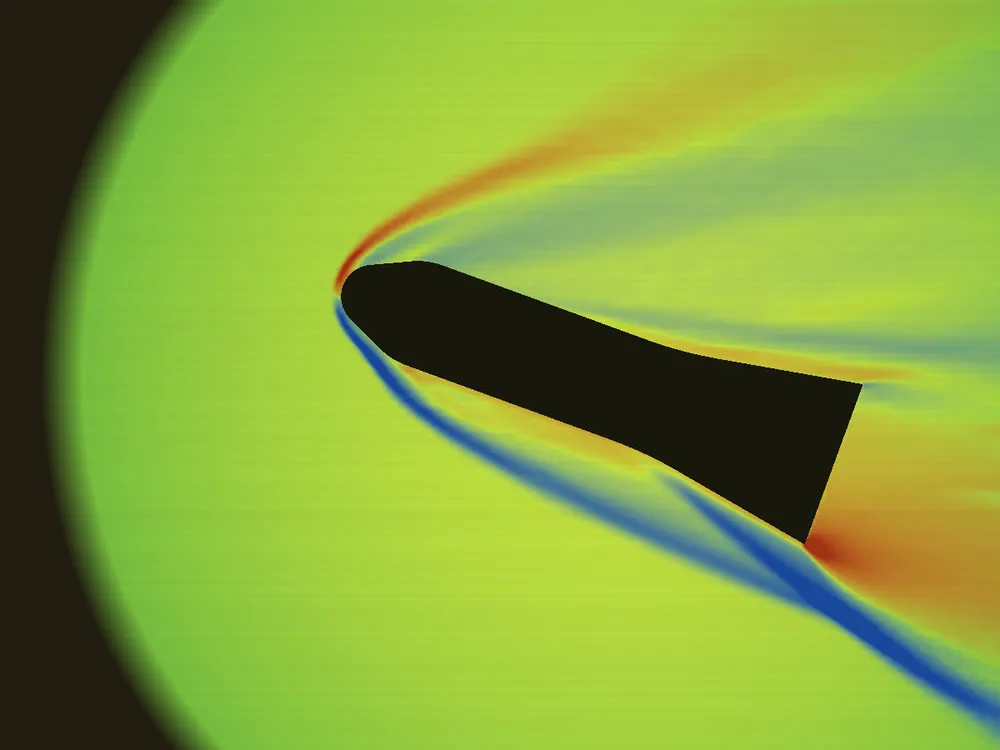
A body after DLR’s ReFEx at Mach 2.5, 28°
A winged re-entry body of several parts, drawn as DLR’s published schlieren photograph shows the tunnel model: the bow shock from the nose and the shocks off the fins.
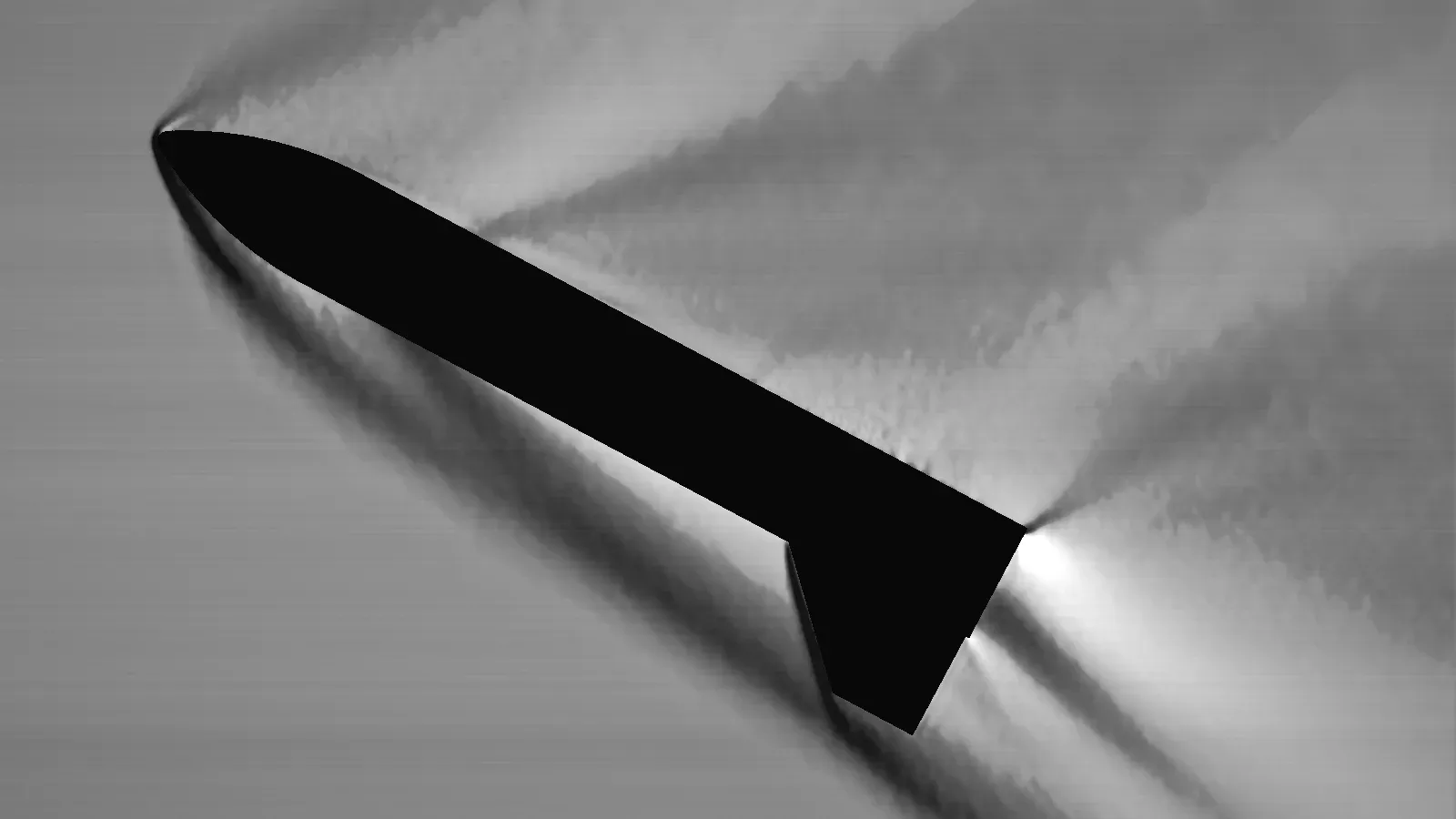
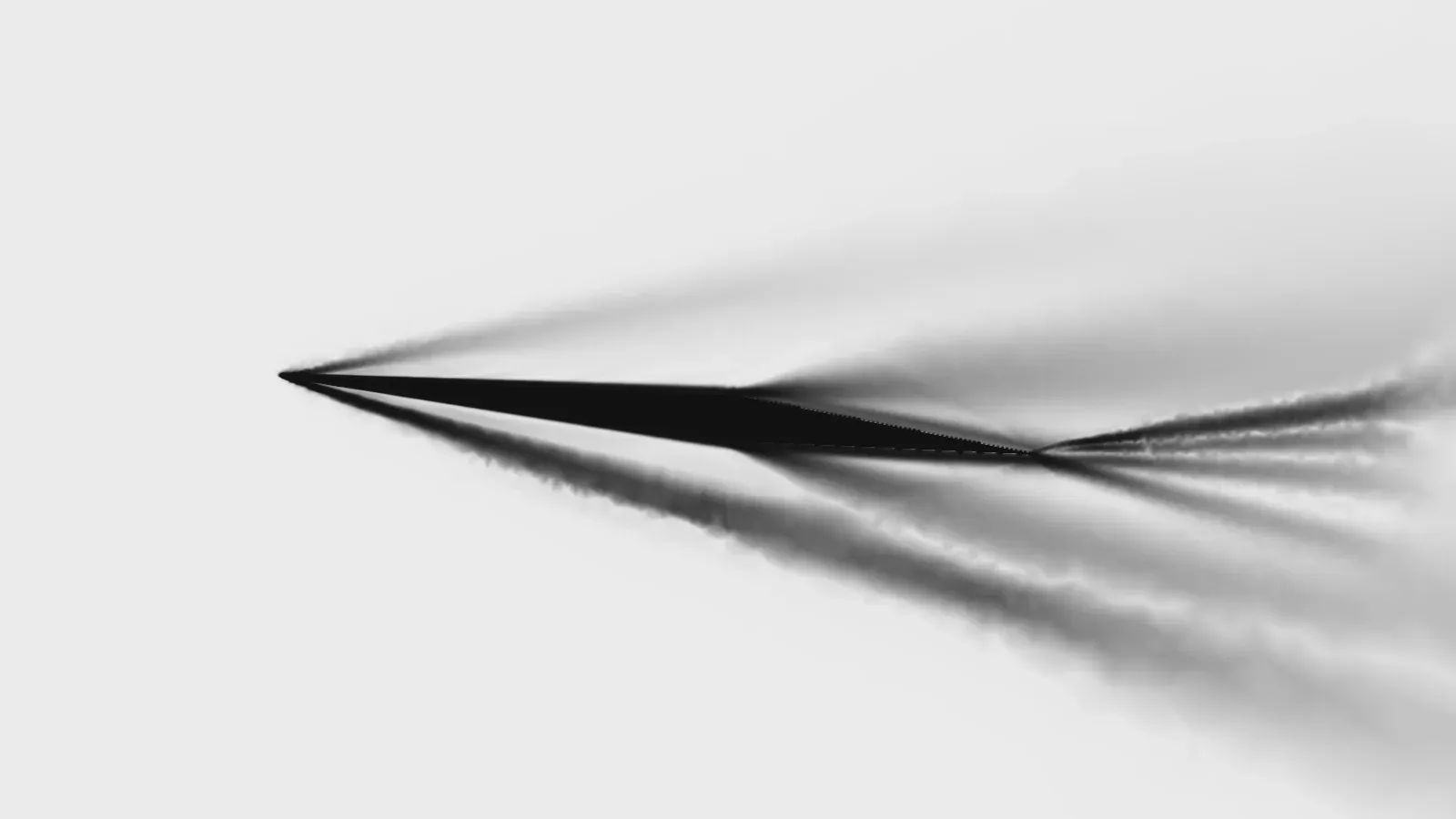
A delta wing at Mach 4.63, 6°
Wing 1 of NASA TN D-7583, at the tunnel’s Mach number and angle: the shock under the wing and the wake behind it. Its lift and drag are charted below.
The numbers
Forces and pressures, against the tunnels’ own curves.
The grey lines are the tunnels’ results as published; the coloured line is Deneb Aero, run on the same models at the same conditions, with a mark at each solved angle. One mesh per case so far; a mesh-refinement study is still to come.
- AEDC Tunnel A
- VTI
- Deneb Aero, a mark at each run
- AEDC Tunnel A
- Deneb Aero
- NASA Langley UPWT
- Deneb Aero, a mark at each run
- NASA Langley UPWT
- Deneb Aero, a mark at each run
Tunnel data: J. D. Gray, AEDC-TDR-64-137 (1964); L. S. Jernell, NASA TN D-7583 (1974). Tunnel photographs: D. Damljanović et al., Aerospace 8 (2021) 275, CC BY 4.0.
The report
Each run ends in a report, this one with 22 figures and the method beside each number.
The jet at Mach 4, as the Studio writes it up: the schlieren, shocks and pressures, lift and drag with their convergence, the skin’s temperature, and the boom on the ground. As HTML, or printed to PDF.
Open the jet’s report