Propulsion
The Propulsion step places the lift rotors and the forward motor, chooses their propellers and motors, and sets up the battery.
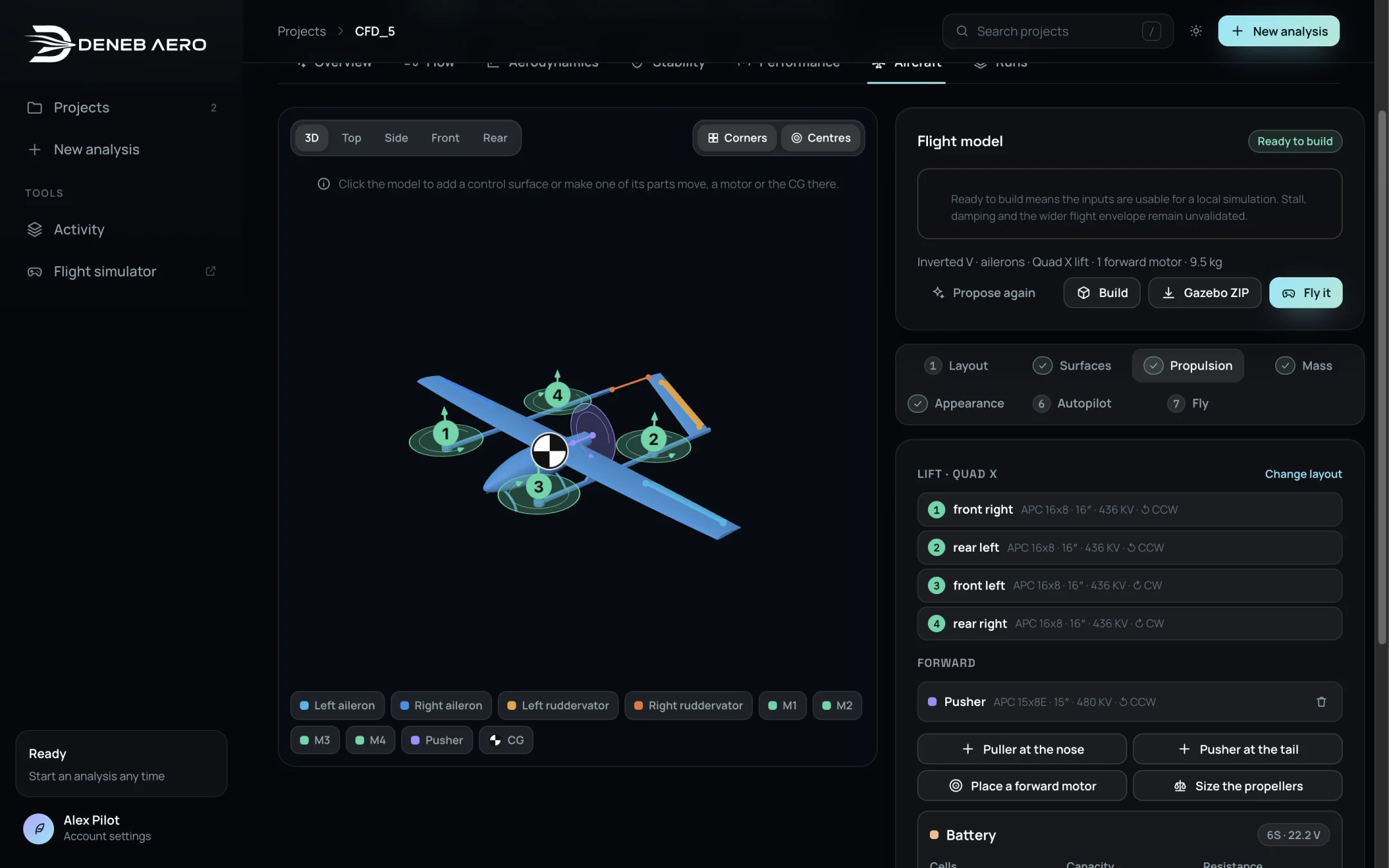
The Propulsion step.
Rotors and motors
The list shows each lift rotor with its number, position (for example front right), propeller, motor KV and spin direction (↻ CW or ↺ CCW), and the forward motor. Change layout returns to the Layout step.
Puller at the nose and Pusher at the tail place the forward motor.
Place a forward motor places it where you click on the model.
Size the propellers proposes propellers for the mass and the speed.
Select a rotor to edit its position, thrust direction, propeller and motor.
Motor data
Give the motor’s datasheet to fly on its real thrust, current and battery:
Motor model |
The name of the motor. |
KV |
Speed constant, rpm per volt. |
Resistance |
Winding resistance. |
No-load current |
Current with no load. |
Current limit |
The maximum current. |
Top speed |
Reached at full throttle, whatever the battery. |
Propeller weight |
Sets how quickly the motor answers. Estimated from the diameter until entered. |
Thrust test table |
The maker’s table for this motor on this propeller, with the voltage it was Tested at. |
When one motor has a datasheet, every electric motor of the aircraft runs on the battery; the others start from an estimate that keeps their top speed.
Battery
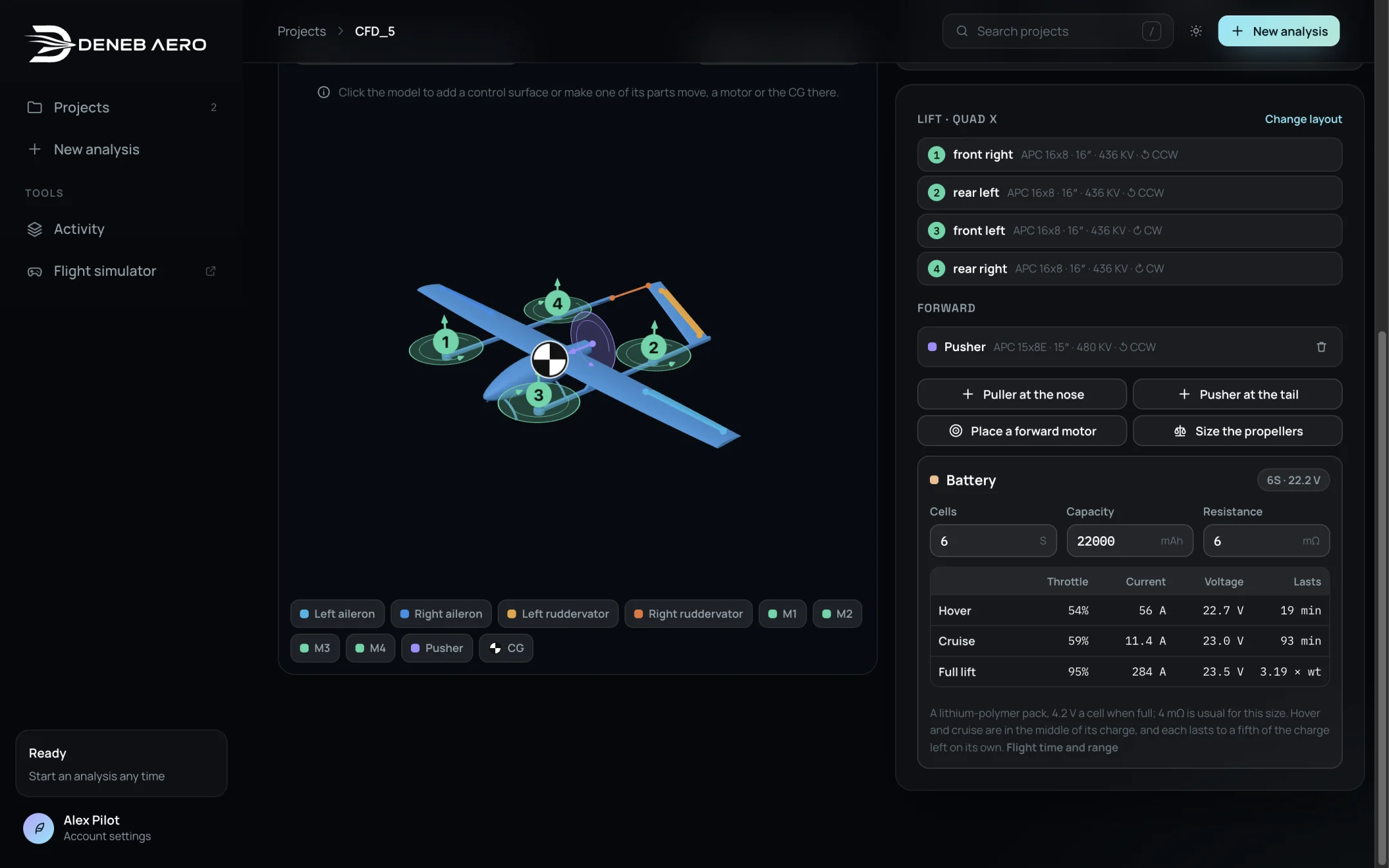
The battery and the operating points.
Cells (S), Capacity (mAh) and Resistance (mΩ) describe a lithium-polymer pack at 4.2 V a cell when full. The table shows, for Hover, Cruise and Full lift, the throttle, current, voltage and how long it lasts down to a fifth of the charge (for full lift, the thrust to weight ratio).
If the lift motors cannot hold the weight in the middle of the battery’s charge, a warning is shown.