Stability Tab
The Stability tab shows the static stability of the aircraft in pitch and in yaw and roll.
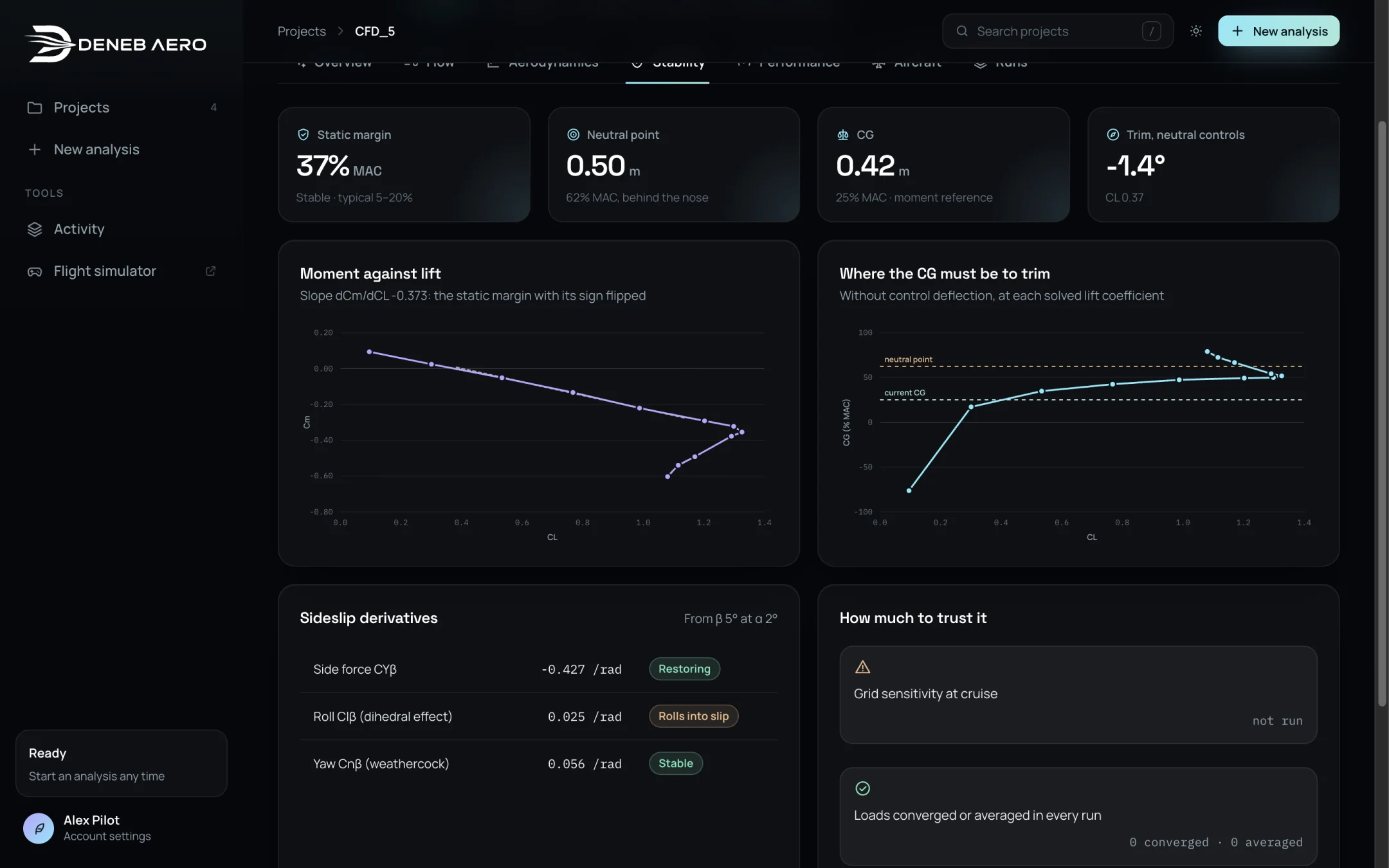
The Stability tab.
Cards
- Static margin
(xNP − xCG) / MAC, in percent. Positive is stable. The card shows a typical range of 5–20%.
- Neutral point
The CG position at which the aircraft would be neutrally stable, measured from the nose, and in percent of the mean chord.
- CG
The CG used as the moment reference.
- Trim, neutral controls
The angle of attack and lift coefficient at which Cm is zero with no control deflection.
Charts
- Moment against lift
Cm against CL. Its slope dCm/dCL is the static margin with its sign flipped.
- Where the CG must be to trim
For each solved lift coefficient, the CG position at which the aircraft trims without control deflection, with the neutral point and the current CG marked.
Sideslip derivatives
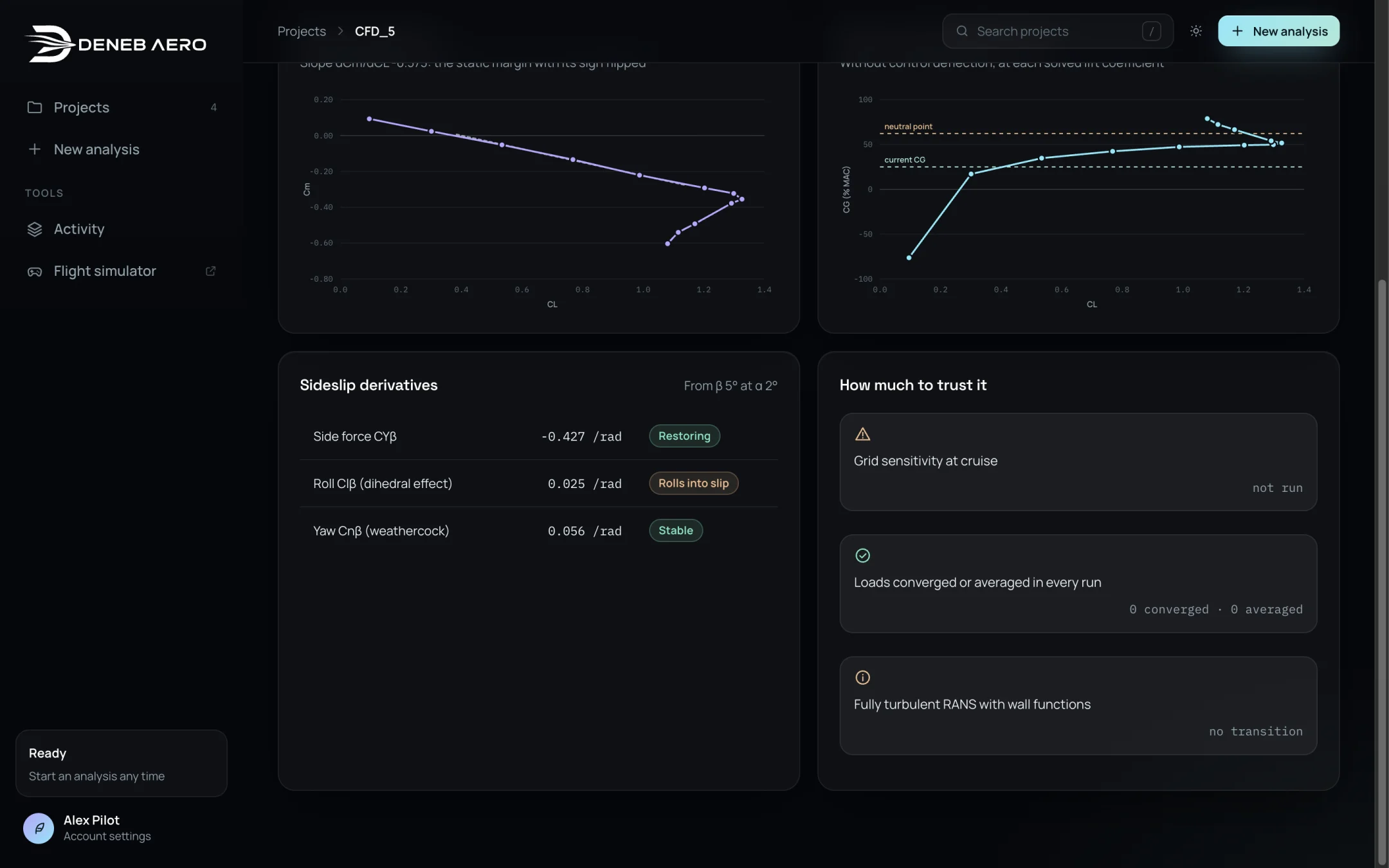
Sideslip derivatives and the confidence card.
From the β 5° run at α 2°, per radian:
Derivative |
Reading |
|---|---|
Side force CYβ |
Negative is restoring. |
Roll Clβ (dihedral effect) |
The rolling moment due to sideslip. Its sign is shown in body axes; the card states whether the aircraft rolls into or away from the slip. |
Yaw Cnβ (weathercock) |
Positive is stable: the nose turns into the wind. |
How much to trust it
This card lists the evidence behind the stability numbers: whether a grid sensitivity check was run at cruise, how many runs converged or were averaged, and the turbulence modelling of the runs used. See Limitations.
The control effectiveness, the pitch trim with the controls and the hinge moments are given in the report (Engineering Report).